
Fosses Septiques and the “new” French Septic Tanks regulations in France.
An introduction including Compact Domestic Wastewater Treatment Plants from Klargester France
New Regulations - domestic Wastewater Treatment Plants France Oct 2009 - click here
The regulations regarding wastewater treatment in France are currently in a state
of constant evolution, although for installations over 20 equivalent inhabitants,
or for compact wastewater treatment plants situations Klar Environnement can now
get your Certificate of Conformity authorised - please click here for more details . klargester France installed treatment systems for
local authorities in France as early as 1986, systems that are still successfully
in operation, but then Klargester has 44 years of experience in this field. France
accepted and signed the new EN 12566-3 septic tank regulations in France in 2005
for implementation no later than March 2008 and AFNOR (the French equivalent of
the British Standards) issued a specification number for these European regulations
to ease them into French law. Unfortunately the French authorities have been slow
to react to these changes and so have had huge fines over successive years from
the EEC for their reluctance to “clean up their act” under increasing ecological
pressures.
 |
If you wish to be uncharitable, this could be seen to be related to the scarcity of any French manufactured compact wastewater treatment systems capable of passing the 40 weeks intensive and independent tests necessary to obtain the EN 12566 part 3 certification. Certain French manufacturers may try to reassure potential purchasers by making claims that their products are manufactured in accordance with FR EN 12566-3 requirements (“aux normes europeen”), but if you don’t see a CE EN 12566 - 3 performance certificate like this you have no guarantees of their waste treatment plants treatment efficiency or eventually their legality. If you have any doubts or wish to check the compliance of a waste treatment plant you are offered, contact us and we will establish if it is certified for you. We encourage competition, but can you really compare a Rolls Royce to a Trabant? They may both be cars, but can they really be compared? |
If considering choosing the convenience and odour free ecological performance of a compact wastewater treatment plant in France, be 100% certain that it is CE marked for treatment performance and tested and certified to FR EN 12566-3 standard. (not to be confused with the CE mark for electrical compliance some manufacturers issue themselves to smoke-screen potential purchasers.) Experts abound on the subject of whether compact wastewater treatment plants are legal for installation in France, including some of the French local authorities and SPANC ‘s, but if the products are certified to FR EN 12566 – 3, regulations that France has accepted and issued a Normes de France classification for, you can install them in your French property, secure in the knowledge that as you are not polluting there are no regulations that you are in contravention of. This is exactly what our many French clients do every week, including Mayors, Chateau’s, entire villages, the Paris port authorities (we have a BioDisc system in daily use at the foot of the Eiffel tower in Paris that outputs directly into the Seine!) The French are used to confused and ambiguous, out of date regulations that most French residents have the common sense to ignore, especially when they have every reason to make a sensible and cost effective choice that is ecologically proven to reduce pollution and that is in the process of being ratified, however long that may take. To fully understand why nobody can give you a definitive answer on the laws governing wastewater treatment in France, you have to understand their legal system. Firstly a proposal or consultation paper is presented to the government, usually formulated by “experts”. After a period of consultation this is either voted in or not as a “law” – the problem being it then needs an application document to be issued before it passes into current law – and some “laws” passed never get this final stage completed – and it all takes a long time!
In rural areas of France where houses are spaced so far apart that a centralised sewerage system (or tout à l’égout) would be too expensive to install, people install their own, private compact sewage treatment facilities. These are traditionally septic tanks, fosses septiques, fosse sceptics or the newest and most efficient option is a “micro stations d’épuration” or compact sewage treatment plant – of which, more anon.
Traditionally a septic tank or fosse septique in France is simply a big concrete or plastic tank that is buried in the garden. Hence why the French are accredited with inventing perfume?!
The septic tank should hold a minimum of 3000 litres of wastewater in a toutes eaux system and when sizing a French fosse septique you should allow 1000 litres for each bedroom of your property in France.
Wastewater flows into the tank at one end and leaves the tank at the other in what is basically only really a pre-treated state and still containing up to 75% of the bacteria levels of raw effluent. Hence the new regulations for fosse septiques in France being applied based on the European regulations EN12566 - 3.
A standard concrete fosse sceptic tank looks like this in cross-section:
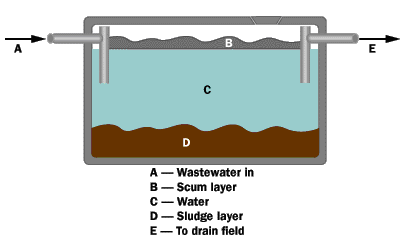
In this picture, you can see three layers in the fosses septiques tank. Anything that floats rises to the top and forms a layer known as the scum layer. Anything heavier than water sinks to form the sludge layer. In the middle is a liquid effluent layer. This body of water contains bacteria and chemicals like nitrogen and phosphorous that can act as fertilizers, but it is largely free of solids.
In a fosse toutes eaux (all water) system, wastewater enters the septic tank as shown below, although on more recent systems where the septic tank system or fosse septic is more than 10 metres from the house; the sink, shower and bath wastes pass through a grease trap first. All parts of the fosse must be a minimum of three metres from a boundary, trees or bushes and be on near level ground. To see the technical details in French for a fosse toutes eaux - click here
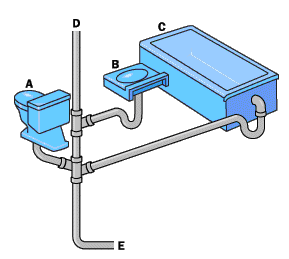
Septic tanks or fosses septiques naturally produce waste gases (caused by bacteria eating the organic material in wastewater), and these gases usually smell being methane based and a byproduct of anaerobic treatment (ie. Oxygen starved). Outlets inside the house should therefore have traps that hold water in the lower loop and block these gases from flowing back into the property. The gases flow up a vent pipe instead – on older fosses this will be a thin pipe coming through the roof or maybe even something that looks like a grey mushroom poking up through the lawn. Recent systems required a 100mm pipe that vents at the ridge height of the French property, mainly to prevent the premature “rotting” of the concrete tank, so it often pays to be cautious when siting new velux windows! One of the ways of knowing you bought a French property is that stomach churning stench of fermenting anaerobic “wastewater” that greets any attempt to open a window or velux for ventilation in summer!
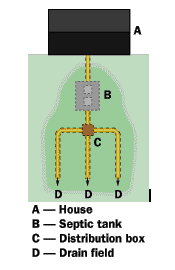
As new water enters the septic tank, it displaces the water that's already there. In technical terms – this will still be laden with pollutants at about 70% or 300mg/litre of DBO5 (which is often referred to as BOD in the uk see www.thebodfactor.com for an in depth explanation). This water flows out of the septic tank and into a soakaway or tranchées d’épandage where soil conditions allow. Traditionally this is perforated pipes buried in trenches filled with gravel in the hope that the water would soak away. Unfortunately the downside is a gradual pollution of the surrounding earth and seepage of nitrates and phosphates into the ground-water, already a problem in many areas of France. Also, as many owners of septic tank treatment based systems understandably omit to annually remove and clean out their pre-filters and grease traps, these trenches often become stinking and sodden grease blocked corners of the garden. The following diagram shows an overhead view of a house, septic tank, distribution box and soak-away, though in a French fosse sceptique there is normally a return at the end of the drains back to another inspection hatch or règard : (To see the technical details in French for tranchées d’epandage - click here
 A typical drain field pipe is 10 centimetres in diameter and is buried in a trench
that is about 1.5 m deep 0.6 m wide. The gravel fills the bottom 60cm of the trench
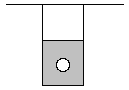
and dirt covers the gravel, like this:
A typical drain field pipe is 10 centimetres in diameter and is buried in a trench
that is about 1.5 m deep 0.6 m wide. The gravel fills the bottom 60cm of the trench
and dirt covers the gravel, like this:
Ideally, the water from the fosse septique or septic tank is slowly absorbed and
treated by the bacteria in the soak-away. The size of this épandage is determined
by how well the ground absorbs water, which can now be determined by having a soil
test done – or étude de sol. Even if you hadn’t planned on replacing your fosses
septiques you will probably soon have a visit from the SPANC The Service Public
d’Assainissement Non Collectif to give you a fosse inspection, whether you like
it or not. In places where the ground is hard clay, rocky and absorbs water very
slowly or too quickly, the etude de sol can make recommendations as follows:
Soak-away bed or Lits d’épandage such as:
LIT FILTRANT VERTICAL NON DRAINE;
Where the ground is insufficiently permeable or conversely is too permeable (calcaire) for a fosse septique with soakaway trenches you will probably be advised to install a lit filtrant. To see the technical details in French for a lit filtrant see here; This is for ground of medium permeability and involves digging a huge hole, filling it with gravel, laying down a specified pattern and length of drainage pipes, covering this with geo-textile fabric, to stop the soil filtering down into the gravel drainage bed and then covering the whole thing over with top soil. This then becomes the greenest and smelliest part of your lawn!
TETRE D’INFILTRATION;
Where your soil is unsuitable for a natural drainage the sand filter outlet or filtre a sable is used for dealing with the wastewater overflow from your septic tank. While sand filters work in theory, they have rapidly been proven to be problematic and costly (see below) To see the technical details in French for a sand filter or tertre d’infiltration click here
FILTRE A SABLE VERTICAL DRAINE
These onerous measures are only taken where your soil is really unsuitable for a traditional type drainage bed and has the water table or a watercourse, stream or river close by. This is the raised sand bed filter and looks like you have a nuclear bunker under your lawn! This is also, unfortunately, often the most expensive "traditional" type of fosse septique or septic tank as it usually requires an electric pumping station to lift the effluent water to the top of the sand bed. The “treated” effluent then drains off into a drainage ditch and often still smells nauseatingly with poor effluent quality. The main problems with sand-filters is their tendency for water-logging and blocking up (called colmatage in French) – which in certain areas or circumstances can occur in as little as 5 years and systematically occurs around 10 years. The cost of remedial action often exceeds the original installation, with depolluation of the removed sand currently costing around 100 euros per ton; This is on top of the considerable upheaval, cost and inconvenience of the work involved. Sand filters are also renowned for the repugnant smell every time a toilet is flushed or bath emptied – definitely to be avoided close to any part of the garden you hope to use in the summer. To see the technical details in French for a raised sand bed filter or filtre a sable drainé see here
Compact Fosse Systems
In restricted circumstances the French traditionally allowed the installation of Zeolite type filters after a 5000 litre fosse septique tank that then drain off to the ditch. (often referred to as Eparco compact systems – although there are other manufacturers.) Unfortunately, and in addition to their considerable cost and a restriction that they can only treat the wastewater of a property with three bedrooms (5 pieces principal) due to a combination of not lasting very long (2-3 years in continuous use) and a tendency to block up or produce sub-standard effluent quality, many of the local authorities are reluctant to allow their installation, despite them still being officially “legal”. Searches in French on search engines will uncover many French clients with ongoing legal battles over non functioning zeolite based systems. As the compact wastewater treatment systems such as the BioDisc and Biotec start at only a little over 2 metres square, they are often much better adapted than these so called compact fosses and are gaining acceptance by local authorities especially in holiday homes or for properties of 4 beds and above with restricted land where the French regulations had no suggestions..For an example of an installation in restricted circumstances in the 29 area of Finistere in Brittany, see here
New European and French Normes NF EN 12566 - 3
Otherwise called Fosses Septiques Compacte, Micro Stations d’épuration or Compact Wastewater Treatment Plants;
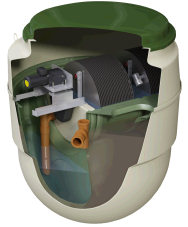
In an exciting new development Klargester wastewater treatment plants, Titan domestic wastewater treatment plants, Kingspan domestic sewage treatment plants and CPC treatment plants are now available for installation in France exclusively through Klar Environnement. This complete range of high performance compact sewage treatment plants offers simple installation, high quality, consistent and odour free treatment, low maintenance and minimal ongoing costs. With purpose sized plants, the range caters for wastewater treatment installations from 1 to 500 people (or even more) and can be used for single or multiple properties. This is the nearest to a mains drainage system you can install chez vous. For French installations for over 20 person equivalent habitation (gite complexes, bed and breakfasts, campsites, hotels, caravan parks, small estates etc) these systems are certificated and approved for automatic acceptance and granting of “certificat de conformité”. For installation in restricted spaces derogation, or permission, can be sought and granted. Most of our clients, who are French, just make the choice to have arguably the best waste treatment system available in France installed, secure in the knowledge that no regulation exists in France to bother them if they are not polluting – and with the Klargester you are guaranteed not to. The “certificat de conformité” has no practical use in France yet anyway, with a proposed use relating to property sales possibly to be introduced in 2012. This will be superceded anyway by Frances adoption of the European Normes NF EN 12566-3 for waste treatment based on the pollution results of the treated effluent. Worth noting that when this is implemented a sand filter arrangement is highly unlikely to meet the required standard. Typically these compact fosse septiques have been used on new builds, barn conversions and renovations, gite complexes, hotels or to simply replace existing septic tanks which no longer comply with the new fosse septique regulations in France. These compact fosse septiques are particularly suitable where a traditional septic tank installation would involve ruining a mature and attractive domestic garden, where the property in France simply doesn’t have enough land to accommodate a normal fosse sceptic or where the householder prefers an ecological and odour free solution to their wastewater treatment requirements. Our entire range is CE marked and certified to EN12566-3 2005, the new European standard covering wastewater treatment plants, making it fully compliant with UK Building Regulations, normal Environment and SEPA specifications and French DTU and AFNOR regulations. Klargester are the largest and most experienced supplier of compact wastewater treatment plants in Europe, possibly the world, When your best option for wastewater treatment comes at the same price or less than a smelly old fosse septique, why wouldn’t you want one?
To find approved installers of Septic Tanks in Brittany or France to benefit from the extended warranty or to get a quote for supply including delivery to your door of Klargester Compact wastewater treatment plants in France ...CLICK HERE